
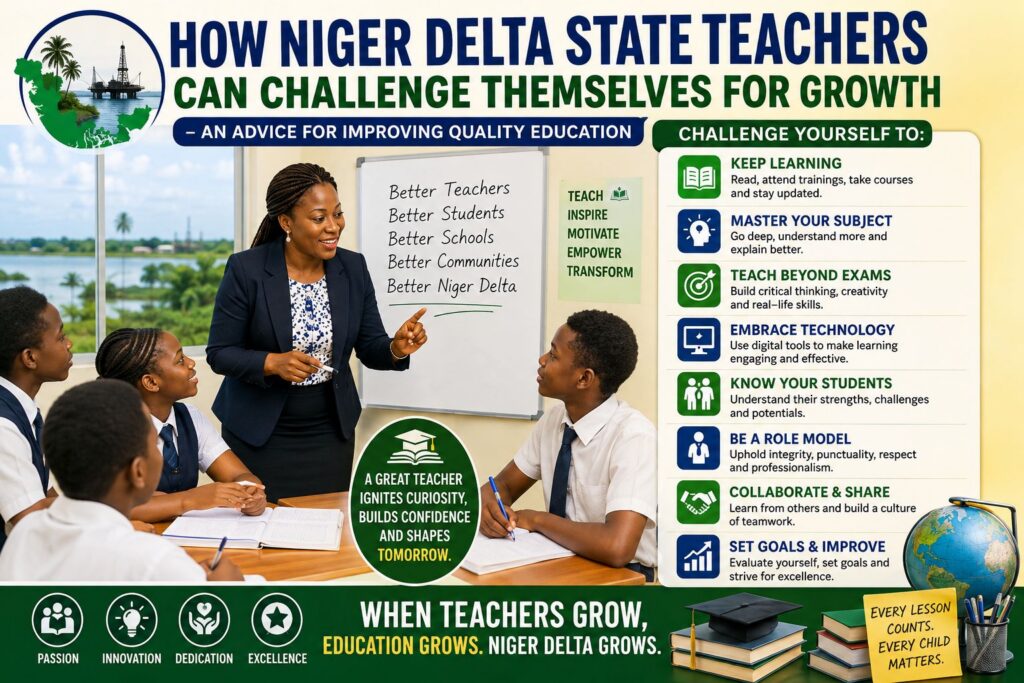
— An Advice for Improving the Quality of Education in the Niger Delta
The quality of education in the Niger Delta cannot rise above the quality, commitment and continuous development of its teachers.
Teachers occupy one of the most influential positions in society. They do not merely teach Mathematics, English, Science, Social Studies or other subjects; they help shape the intellectual capacity, character, confidence and future possibilities of an entire generation.
For this reason, teachers in the Niger Delta should not wait for government, school proprietors, parents or educational agencies to provide every motivation for improvement. Every teacher must learn to challenge himself or herself for growth.
The question should no longer be:
“What has the government done for me?”
but also:
“What am I doing to become a better teacher?”
Improving education requires better infrastructure, policies, funding and welfare. However, even within existing limitations, teachers can make significant progress by deliberately improving their knowledge, teaching methods, professional attitude and commitment to students.
1. DEVELOP A PERSONAL CULTURE OF CONTINUOUS LEARNING
A teacher who stops learning will eventually become outdated.
The world is changing rapidly. New technologies, teaching methods, research findings and educational approaches emerge continually. Students today also learn differently from students of previous generations.
Therefore, Niger Delta teachers should make professional learning a personal responsibility.
Challenge yourself to:
Read educational books regularly.
Attend seminars and teacher-training programmes.
Participate in workshops.
Take online courses.
Learn new teaching strategies.
Study your subject beyond the school curriculum.
Follow developments in education.
Learn from experienced teachers.
Read academic journals and educational materials.
Reflect on new ways of helping students understand difficult concepts.
A teacher should be able to say:
“I am better at teaching this year than I was last year.”
2. MASTER YOUR SUBJECT
One of the greatest challenges facing education is inadequate mastery of subject matter.
A teacher should not depend exclusively on the textbook.
If you teach Mathematics, study Mathematics deeply.
If you teach English, improve your vocabulary, grammar, pronunciation and communication skills.
If you teach Biology, Chemistry, Physics or Basic Science, continue exploring scientific developments.
Students should see their teachers as reliable sources of knowledge.
Challenge yourself to become the teacher students can approach when they encounter difficult concepts.
Before entering the classroom, ask:
Do I understand this topic completely?
Can I explain it in simple language?
Can I give practical examples?
Can I answer likely questions from students?
Can I connect this topic to real life?
3. STOP TEACHING ONLY FOR EXAMINATION
Examinations are important, but education must go beyond examination scores.
A student may score 90% in an examination and still lack critical thinking, communication skills, creativity and problem-solving ability.
Teachers should therefore challenge students to understand why rather than merely memorize what.
Instead of asking only:
“What is the answer?”
ask:
“Why is this the answer?”
Instead of:
“Define photosynthesis.”
also ask:
“Why is photosynthesis important to human life?”
Instead of teaching students to reproduce information, teach them to think, analyse, question, investigate and apply knowledge.
4. MAKE YOUR CLASSROOM MORE PRACTICAL
Students learn better when they can connect classroom knowledge to real life.
Niger Delta teachers have a unique opportunity to use their environment as a learning laboratory.
For example:
Science teachers
Can use local environmental issues to teach:
Pollution
Water quality
Ecosystems
Biodiversity
Climate change
Oil-spill impacts
Conservation
Agriculture
Geography teachers
Can teach using:
Rivers
Creeks
Mangroves
Communities
Coastal environments
Transportation systems
Urban development
Economics teachers
Can discuss:
Local businesses
Fishing
Agriculture
Oil and gas
Entrepreneurship
Household economics
Employment
English teachers
Can encourage students to write:
Newspaper articles
Essays
Speeches
Stories
Reports
Interviews
Debates
The environment around the student can become a classroom.
5. EMBRACE TECHNOLOGY
A modern teacher should not be afraid of technology.
Technology should not replace teachers, but teachers who understand technology can become more effective.
Teachers should gradually learn how to use:
Smartphones
Computers
Projectors
Educational videos
Digital presentations
Online learning platforms
Artificial intelligence tools
Digital assessment tools
Educational websites
Online libraries
The goal is not to use technology simply because it is fashionable.
The goal is to ask:
“Can this technology help my students understand this subject better?”
If the answer is yes, learn how to use it.
6. LEARN TO USE ARTIFICIAL INTELLIGENCE RESPONSIBLY
Artificial intelligence is becoming increasingly important in education.
Teachers should not simply fear AI or see it as a threat.
They should learn how to use it responsibly for:
Lesson planning
Generating teaching ideas
Creating practice questions
Differentiating lessons
Developing quizzes
Creating learning activities
Simplifying difficult concepts
Brainstorming examples
Supporting research
However, teachers must verify AI-generated information before presenting it to students.
AI should assist the teacher—not replace the teacher’s professional judgment.
7. KNOW YOUR STUDENTS INDIVIDUALLY
Every classroom contains students with different abilities.
Some learn quickly.
Some need more explanation.
Some are shy.
Some are exceptionally gifted.
Some struggle with reading.
Some have excellent ideas but lack confidence.
Some perform poorly in examinations but possess remarkable practical intelligence.
A good teacher should therefore avoid treating every student exactly the same.
Challenge yourself to know:
Who is struggling?
Who is improving?
Who needs encouragement?
Who needs additional exercises?
Who is gifted?
Who is losing interest?
Who needs mentorship?
Teaching is not just about delivering lessons; it is about understanding learners.
8. MAKE WEAK STUDENTS A PERSONAL CHALLENGE
One of the greatest measures of a teacher is not how well the best student performs.
It is how much the struggling student improves.
Teachers should challenge themselves by asking:
“How many students who previously struggled have I helped to improve?”
Create intervention strategies for weaker students.
Give them:
Additional explanations
Extra exercises
Peer support
Individual attention
Encouragement
Revision sessions
Practical examples
Do not quickly label a student as “dull.”
Sometimes the problem is not intelligence.
The problem may be:
Poor foundation
Fear
Lack of confidence
Poor study habits
Language difficulties
Lack of support
Inappropriate teaching methods
9. DEVELOP STRONG COMMUNICATION SKILLS
A teacher may possess excellent knowledge but fail to communicate it effectively.
Teachers should improve:
Public speaking
Pronunciation
Vocabulary
Listening
Questioning techniques
Storytelling
Classroom instructions
Non-verbal communication
A complicated idea should be capable of being explained simply.
If students consistently fail to understand you, do not always blame the students. Examine your method.
10. CREATE A CULTURE OF QUESTIONING
A classroom should not be a place where the teacher does all the talking.
Students should be encouraged to ask questions.
A teacher should be comfortable hearing:
“Sir, I don’t understand.”
or
“Ma, why does this happen?”
Questions indicate intellectual engagement.
Teachers should therefore create an atmosphere where students can ask questions without being ridiculed.
Challenge students with:
Why?
How?
What if?
What would happen if…?
Can you prove it?
Can you give another example?
Can you find another solution?
This develops critical thinking.
11. ENCOURAGE READING CULTURE
A society that does not read will struggle to develop intellectually.
Teachers should become reading models.
Students are more likely to take reading seriously when they see teachers reading.
Schools can establish:
Reading clubs
Book competitions
Essay competitions
Debate clubs
Spelling competitions
Public speaking programmes
Literary societies
Research projects
Every teacher can contribute to developing a reading culture.
12. MAKE PROFESSIONAL ETHICS A PRIORITY
Growth is not only about academic knowledge.
It is also about character.
Teachers should demonstrate:
Punctuality
Honesty
Fairness
Discipline
Respect
Professionalism
Responsibility
Confidentiality
Commitment
A teacher who regularly arrives late sends a message to students about the value of time.
A teacher who humiliates students teaches them that knowledge gives permission to disrespect others.
A teacher who cheats teaches students that integrity is optional.
Teachers teach by their behaviour as much as by their words.
13. STOP HUMILIATING STUDENTS
Public humiliation should not be used as a primary teaching strategy.
Calling a student “stupid,” “useless,” “dull” or “a failure” can damage confidence.
Correct the behaviour without destroying the person.
Instead of:
“You are very dull.”
say:
“You have not understood this yet. Let’s try another approach.”
The word “yet” can change a student’s mindset.
14. DEVELOP A HABIT OF SELF-ASSESSMENT
At the end of every term, teachers should evaluate themselves.
Ask:
Teaching performance
What did I teach well?
What did I teach poorly?
Which topics were difficult for students?
What methods worked?
Student performance
Which students improved?
Which students declined?
Why?
Professional development
What new skill did I acquire?
What should I learn next?
Classroom management
Was my classroom orderly?
Did students participate actively?
Self-evaluation transforms experience into professional growth.
15. LEARN FROM OTHER TEACHERS
No teacher knows everything.
Teachers should develop professional communities where they share:
Lesson plans
Teaching strategies
Educational resources
Examination techniques
Classroom experiences
Solutions to difficult teaching problems
Experienced teachers should mentor younger teachers.
Younger teachers should also bring new ideas.
Professional collaboration is not competition.
When one teacher improves, the school improves.
16. CREATE HEALTHY COMPETITION AMONG TEACHERS
Competition can be used positively.
Schools can recognize:
Most improved teacher
Best lesson presentation
Best classroom management
Most innovative teacher
Best use of technology
Best student improvement
Best research project
Best extracurricular programme
The purpose should not be to embarrass weaker teachers but to inspire everyone to improve.
17. SET PERSONAL PROFESSIONAL GOALS
Every teacher should have measurable yearly goals.
For example:
My 2026 Teacher Growth Goals
Read 12 educational books.
Complete two online courses.
Learn one new digital teaching tool.
Improve my lesson planning.
Help at least 10 struggling students improve.
Introduce one practical project into my subject.
Attend two professional workshops.
Establish a reading activity for students.
Improve my public speaking.
Mentor at least one younger teacher.
Growth becomes easier when it is measurable.
18. DEVELOP STUDENTS FOR THE FUTURE, NOT JUST FOR TODAY
The Niger Delta needs students who can compete beyond their immediate environment.
Teachers should prepare students for a world requiring:
Critical thinking
Creativity
Communication
Collaboration
Digital literacy
Entrepreneurship
Research
Problem-solving
Leadership
A student should leave school asking:
“What can I contribute to society?”
not merely:
“What certificate can I obtain?”
19. TURN LOCAL PROBLEMS INTO LEARNING OPPORTUNITIES
The Niger Delta has many challenges that can become educational opportunities.
Students can conduct projects around:
Environmental pollution
Flooding
Waste management
Water quality
Agriculture
Fisheries
Renewable energy
Transportation
Entrepreneurship
Community development
Teachers can challenge students to identify a local problem and propose a solution.
This transforms education from memorisation into innovation.
20. BUILD A STRONGER RELATIONSHIP WITH PARENTS
Education cannot succeed when teachers and parents operate as enemies.
Teachers should communicate constructively with parents about:
Academic performance
Behaviour
Attendance
Strengths
Weaknesses
Areas requiring support
Parents should not hear from the school only when their child has a problem.
Celebrate improvement too.
A simple message saying:
“Your child has improved significantly in Mathematics this term.”
can encourage parental involvement.
21. DON’T WAIT FOR GOVERNMENT BEFORE IMPROVING
Government has a major responsibility to provide:
Infrastructure
Teaching materials
Teacher welfare
Training
Adequate staffing
Safe learning environments
But teachers should also ask:
“What can I do with what I currently have?”
A lack of a projector should not prevent a teacher from becoming creative.
A teacher can use:
The board
Local materials
Demonstrations
Group discussions
Role-playing
Outdoor learning
Student presentations
Resource limitations should be challenged with creativity wherever possible.
22. CHALLENGE YOURSELF TO PRODUCE EXCELLENT STUDENTS
A teacher’s greatest legacy is not the number of lessons taught.
It is the lives transformed.
Imagine a teacher who can look back after 10 years and say:
“I helped doctors, engineers, lawyers, scientists, entrepreneurs, teachers and leaders discover their potential.”
That is the true educational impact.
23. A CALL TO NIGER DELTA TEACHERS
The Niger Delta needs teachers who refuse mediocrity.
Teachers who will say:
I will keep learning.
I will improve my teaching.
I will understand my students.
I will embrace technology.
I will encourage questions.
I will help struggling learners.
I will develop gifted learners.
I will uphold professional ethics.
I will collaborate with other teachers.
I will measure my own growth.
I will prepare students for the future.
I will not use yesterday’s methods to solve tomorrow’s problems.
CONCLUSION: THE FUTURE BEGINS IN THE CLASSROOM
Improving the quality of education in the Niger Delta is not the responsibility of the government alone.
It is a collective responsibility involving:
Government + School Owners + Teachers + Parents + Students + Communities + Educational Organisations.
But among all these stakeholders, the teacher remains one of the most direct influences on what happens inside the classroom.
Therefore, every Niger Delta teacher should make personal growth a professional responsibility.
Challenge yourself to become better.
Learn more.
Teach better.
Listen more.
Innovate.
Use technology.
Study your students.
Help the weak.
Develop the gifted.
Collaborate with colleagues.
Measure your results.
And never become comfortable with mediocrity.
Because when the teacher grows, the classroom grows.
When the classroom grows, the student grows.
When students grow, the school grows.
When schools grow, communities grow.
And when communities grow, the Niger Delta grows.
THE QUALITY OF OUR FUTURE DEPENDS, IN PART, ON THE QUALITY OF THE TEACHERS WE DEVELOP TODAY.
[🔓JAILBREAK]
THE NIGER DELTA TEACHER MUST RISE: A CALL TO PROFESSIONAL GROWTH
The Niger Delta does not merely need more teachers.
It needs better teachers.
It needs teachers who are hungry for knowledge, passionate about their students, willing to embrace innovation and courageous enough to examine their own weaknesses.
A teacher should never say:
“This is how I have always taught.”
That statement can become the beginning of professional stagnation.
Instead, the teacher should ask:
“How can I teach this better than I taught it yesterday?”
The transformation of Niger Delta education will not happen simply because new buildings are constructed or new policies are written.
It will happen when teachers themselves become agents of educational transformation.
The challenge is simple:
Don’t compete only with other teachers. Compete with your previous self.
If last year’s students performed at 55%, challenge yourself to move them to 65%.
If students are afraid to ask questions, create a classroom where questions become normal.
If your lessons were mostly theoretical, introduce practical activities.
If you avoid technology, learn one digital tool.
If you have never conducted educational research, start with one small classroom problem.
If five students were struggling last term, determine how many you can help this term.
Growth begins when a teacher refuses to remain at the same level.
A New Standard for the Niger Delta Teacher
The new standard should be:
“I don’t merely complete the syllabus. I develop minds.”
“I don’t merely prepare students for examinations. I prepare them for life.”
“I don’t merely teach what I know. I continue learning what I don’t know.”
“I don’t wait for perfect conditions. I create possibilities with available resources.”
“I don’t measure my success only by how much I taught. I measure it by how much my students understood, improved and became.”
That mindset can transform classrooms across the Niger Delta.
FINAL CHALLENGE
To every teacher in Rivers, Bayelsa, Akwa Ibom, Cross River, Delta, Edo and the wider Niger Delta:
Challenge yourself.
Read one more book.
Learn
one more skill.
Improve one lesson.
Help one struggling student.
Discover one gifted child.
Try one new teaching method.
Use one new technology.
Mentor one young teacher.
Solve one classroom problem.
Inspire one student.
And do it again tomorrow.
Education improves when teachers decide to improve themselves.
The transformation of the Niger Delta classroom can begin with one teacher, one lesson, one student and one decision to become better.