
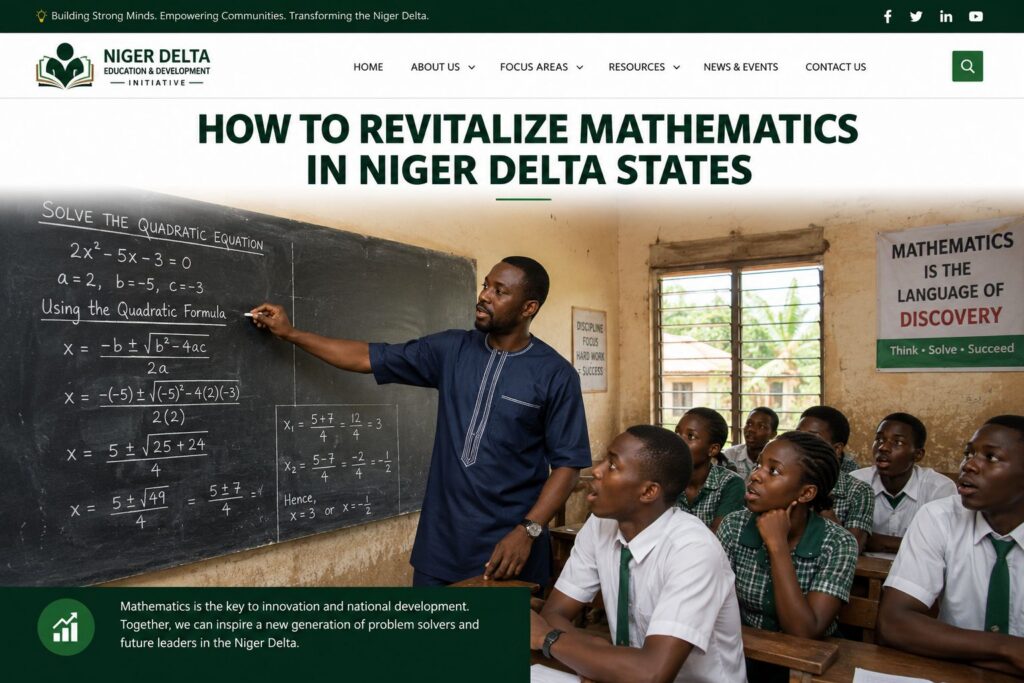
Mathematics is the foundation of scientific innovation, technological advancement, engineering, finance, and economic development. Every developed nation has invested heavily in mathematics education because it equips citizens with analytical thinking, problem-solving abilities, and innovation skills. Unfortunately, mathematics performance in many schools across the Niger Delta Region remains below expectations due to inadequate teaching resources, shortage of qualified teachers, poor learning environments, negative attitudes toward mathematics, and limited practical application of mathematical concepts.
To build a generation capable of driving industrialization, digital transformation, and sustainable development, the Niger Delta Region must embark on a comprehensive strategy to revitalize mathematics education from primary to tertiary levels.
Current Challenges
Several factors contribute to poor mathematics performance in the Niger Delta Region:
1. Shortage of Qualified Mathematics Teachers
Many schools, especially those in rural communities, lack professionally trained mathematics teachers. Some schools assign teachers from unrelated disciplines to teach mathematics.
2. Mathematics Anxiety
Many pupils and students develop fear of mathematics from an early age due to poor teaching methods and repeated failure.
3. Poor Teaching Methods
Teaching is often examination-oriented instead of problem-solving oriented. Students memorize formulas without understanding concepts.
4. Inadequate Learning Facilities
Many schools lack:
Mathematics laboratories
Modern textbooks
Graphical calculators
Interactive learning software
Internet-enabled classrooms
5. Limited Practical Application
Students rarely see how mathematics applies to everyday life, engineering, business, agriculture, oil and gas, ICT, banking, and entrepreneurship.
6. Weak Foundation
Poor numeracy skills developed during primary education continue into secondary school, making advanced mathematics difficult.
Vision
To transform the Niger Delta Region into a center of mathematical excellence where every child possesses strong numeracy, analytical thinking, creativity, and innovation skills capable of competing globally.
Strategic Objectives
The revitalization programme should aim to:
Improve mathematics learning outcomes.
Increase students’ interest in STEM education.
Produce future engineers, scientists, economists, data analysts, programmers, and innovators.
Improve national examination performance.
Bridge urban-rural educational gaps.
Promote digital mathematics learning.
Strategic Approaches
1. Strengthen Early Mathematics Education
The foundation begins in primary schools.
Schools should:
Introduce fun mathematics activities.
Use educational games.
Teach with pictures and objects.
Encourage counting using local materials.
Develop problem-solving rather than memorization.
2. Continuous Teacher Training
Teachers remain the backbone of quality education.
Governments and NGOs should organize:
Annual mathematics workshops
Refresher courses
Digital teaching training
Modern instructional strategies
Classroom assessment techniques
Teachers should also receive certification updates periodically.
3. Establish Mathematics Resource Centres
Each state in the Niger Delta should establish Mathematics Resource Centres equipped with:
Smart classrooms
Mathematics laboratories
Interactive boards
Computer laboratories
Mathematical models
Robotics kits
STEM learning tools
4. Introduce Digital Learning
Technology should become part of mathematics education.
Schools should use:
Interactive mathematics software
Online tutorials
Educational mobile applications
Artificial Intelligence learning assistants
Virtual classrooms
Computer-based assessments
5. Organize Mathematics Competitions
Healthy competition inspires excellence.
Annual competitions should include:
Mathematics Olympiads
Mental Mathematics Challenges
Quiz Competitions
Problem-Solving Championships
Coding Competitions
STEM Innovation Fairs
Such programmes will motivate students to study mathematics beyond examinations.
6. Reward Excellence
Outstanding students and teachers should receive:
Scholarships
Cash prizes
Certificates
Educational grants
Laptops
Scientific calculators
International exchange opportunities
Recognition inspires greater commitment.
7. Improve Teaching Materials
Every school should have access to:
Updated mathematics textbooks
Mathematical instruments
Graph boards
Geometry kits
Scientific calculators
Digital projectors
Interactive learning materials
8. Strengthen School Infrastructure
Learning environments should be conducive by providing:
Well-equipped classrooms
Reliable electricity
Internet connectivity
Functional libraries
Computer laboratories
9. Community Participation
Parents and communities should support mathematics education through:
Home learning support
Mathematics clubs
Educational sponsorship
Volunteer tutoring
Career mentorship
10. Change Public Perception
Public campaigns should emphasize that mathematics is not difficult but learnable.
Media organizations should broadcast:
Mathematics television programmes
Radio quizzes
Educational documentaries
Mathematics success stories
Role of Government
Government should:
Recruit qualified mathematics teachers.
Improve teacher welfare.
Provide grants for STEM education.
Review mathematics curriculum regularly.
Monitor teaching quality.
Introduce mathematics innovation funds.
Partner with private organizations.
Role of Schools
Schools should:
Establish Mathematics Clubs.
Conduct weekly problem-solving sessions.
Organize inter-house mathematics competitions.
Encourage project-based learning.
Integrate ICT into mathematics lessons.
Role of Universities
Higher institutions should:
Train competent mathematics teachers.
Conduct mathematics education research.
Develop innovative teaching methods.
Mentor secondary school teachers.
Organize regional mathematics conferences.
Role of Private Sector
Banks, oil companies, telecommunication firms, and industries operating in the Niger Delta should invest in mathematics education through:
Scholarships
ICT laboratories
Teacher training sponsorship
STEM innovation centres
Mathematics competitions
Internship programmes
Monitoring and Evaluation
Progress should be measured using indicators such as:
Improvement in mathematics examination results.
Increased enrolment in STEM courses.
Number of trained mathematics teachers.
Participation in mathematics competitions.
Student attitudes toward mathematics.
Number of schools equipped with digital learning facilities.
Annual assessments should guide continuous improvement.
Expected Outcomes
If these strategies are implemented effectively, the Niger Delta Region can expect:
Improved mathematics performance in schools.
Increased interest in science and technology.
Better WAEC, NECO, and JAMB mathematics results.
More students pursuing STEM careers.
Enhanced critical thinking and problem-solving skills.
Greater innovation and entrepreneurship.
A stronger workforce capable of supporting regional and national economic development.
Conclusion
Revitalizing mathematics education in the Niger Delta Region is essential for unlocking the region’s human potential and fostering sustainable development. Achieving this goal requires collaboration among governments, schools, teachers, parents, communities, development partners, and the private sector. By investing in quality teaching, modern learning resources, digital technologies, and student motivation, the region can cultivate a generation of mathematically proficient learners who are prepared to solve real-world challenges, drive innovation, and contribute meaningfully to Nigeria’s socioeconomic progress. Mathematics should be viewed not merely as a school subject, but as a powerful tool for transforming lives, strengthening communities, and securing a prosperous future for the Niger Delta.